Sunday, July 13, 2014

Why is interfaith dialogue among religions so important?

It is strange but very disappointing that in spite of so much of progress in science and technology, we human-beings have remained intolerant to other faiths and religions. In other words, the so called religious 'heads' (of almost all religions/faith) and also politicians have continued to 'use' us for their power-political dreams. The worst part of this disturbing 'scenario' is that even highly educated citizens too either subscribe to (or advocate) fanaticism, extremism, aggression, hate and xenophobia or remain 'silent' to these burning issues. Everyone of us, actually, have allowed the misuse of religions (or misused them) unknowingly or deliberately.

The conflict with other religion or not respecting people just because they follow a different faith has, probably, done so much harm to all inclusive growth of mankind. "Today the need to resolve the pressing issues of global concern is paramount. It is imperative that interfaith cooperation is developed to promote the principle of peace. It is very important for all religious people to recognize each other as partners, not adversaries in faith, writes Ghulam Ghuas in NewAgeIslam.com. He believes that the diversity of religions across the world demands tolerance and respect to the other from everyone.


He calls for interfaith dialogue among religions and highlights the the need to resolve the pressing issues of global concern. It is imperative that interfaith cooperation is developed to promote the principle of peace.


Tuesday, June 24, 2014

Muslim Footballers Kick Stereotypes in 20th FIFA World Cup, Brazil

The 2014 FIFA World Cup is the 20th FIFA World Cup, a tournament for the men's football world championship, that is currently taking place in Brazil has an abundance of Muslim players. Dotting the football landscape, Muslim players starring in their different teams from across the world are expected to draw much attention of spectators with special performance. Since, 6 of the 32 teams comes from countries where Islamic presence is substantial and more over 3  of them placed together in Group F, it is almost certain that Muslim players will be involved in the tournament’s latter stages.  


In an article published in web-magazine Newageislam.com it has been pointed that if Muslims make their mark in different ways and as long as these make a positive contribution to society, we must celebrate it. And this should happen not because these players are Muslims, but for the reason that the religion to which they belong is mostly in 'news' for wrong reasons. The article titled 'The Melting Cup: Muslim Footballers Kick Stereotypes in Brazil' has been authored by Saif Shahin. He asks, "Can the success of these Muslim players and the cult status they are gaining kindle a warmer acceptance of Muslim immigrants—and of Islam as a religion—in the heart of Europe"? On current evidence, it seems rather unlikely. Just this year, Switzerland passed a referendum to impose strict limits on immigration. Contesting on anti-immigration and often blatantly Islamophobic platforms, several far right parties won substantial victories in the recently held European parliamentary elections.

Karim Benzema
For obvious reasons, these Muslim players are typically reticent on such issues. But occasionally they do speak out. Ozil, after winning an award for ‘successful integration into German society’, said: “This is a great honour for me and I’m very happy. Integration creates something new and makes for a more colourful Germany.” And referring to France’s National Front, Zidane once warned, “Think - and I stress my words- about the consequences of voting for a party that does not at all correspond to the values of France.” 

Another fact which needs to be mentioned here is that for the first time for 28 years that Ramadan has overlapped with a World Cup. Not only teams including France, Switzerland and Germany have players of Islamic faith, but also Bosnia-Herzegovina, Algeria, Cameroon, Iran, Ivory Coast and Nigeria all have large Muslim populations.


Monday, June 23, 2014

Insanity is doing the same thing over and over again, but expecting different results!

"Our history is replete with the doings of the Ulema who have brought humiliation and disgrace to Islam in every age and period," said Maulana Abul Kalam Azad in an interview o journalist Shorish Kashmiri for a Lahore based Urdu magazine, Chattan, in April 1946. He further asked,"The upholders of truth are exceptions. How many of the Ulema find an honourable mention in the Muslim history of the last 1,300 years? There was one Imam Hanbal, one Ibn Taimiyya. In India we remember no Ulema except Shah Waliullah and his family. The courage of Alf Sani is beyond doubt, but those who filled the royal office with complaints against him and got him imprisoned were also Ulema. Where are they now? Does anybody show any respect to them?"

In a recent discussion at popular web magazine Newageislam.com, Sultan Shahin and Ghulam Mohiyuddin raised questions like - Can Jihadis be dismissed as common criminals or should their wide acceptance as puritans worry Muslims? Is this an ideological issue or a mere law and order problem?


Taliban and Boko Haram are discussed because they are no ordinary criminals. They kill muslims by committing suicide in belief that by doing so they will go to heaven. They, in fact, should be called as Islamist terrorists. They consider themselves followers of what they call "pure" Islam and a large number of Muslims consider them the best of Muslims. These terrorists have admirers among Muslims all over the world including Pakistan. These Islamist terrorists go to mosques with suicide vests and kill themselves during prayer in order to kill fellow Muslims so that they reach heaven instantaneously and take ownership of their 72 wives waiting for them there. Sultan Sahin asks,"Which gang of ordinary criminals - mere law and order problem - does these things"?

Taking this discussion to another level, Ghulam Mohiyuddin write, "Quran does not allow such extremist beliefs and behavior, but the Islamophobes keep quoting from the Quran to contradict us. This back-and-forth has been going on for several years, but it is not getting us anywhere. Even if what we are saying is correct and what the Islamophobes are saying is false, we do need to find NEW ways to make such gross misinterpretations impossible. Einstein defined insanity as: "Doing the same thing over and over again and expecting different results."

Monday, June 16, 2014

Why are there no Muslim philosophers?

Hasan Azad
Few days back, I chanced upon to read this article in a popular web magazine NewAgeIslam.com and thought to share few excerpts from this thought provoking article. Hasan Azad, the author of this article says that his friend posed the question to me that why are there no Muslim philosophers while I was studying some critical Western texts of philosophy in the fall of 2009 with him. Hasan writes,"Although this is a complicated question - which I do not take at face value, given that Kaviraj is himself an important postcolonial thinker - it does point to a significant failure of Muslim thinkers to engage their own intellectual tradition, together with the Western tradition of thought".

He continues and states that on one level the question "Why are there no Muslim philosophers?" is an absurd one. Hamid Dabashi and Walter Mignolo, both major thinkers in their own right, mention the names of a number of Muslim philosophers (Souleymane Bachir Diagne, Azmi Bishara, Sadeq Jalal Al-Azm, Fawwaz Traboulsi, Abdallah Laroui, Abdolkarim Soroush, and Seyyed Hossein Nasr). Wael Hallaq - himself also a very important thinker - has added to that list in his own commentary on the relation of politics and knowledge (Muhammad Arkoun, M Abed al-Jabiri, Ali Harb, Hasan Hanafi, and Muhammad Shahrur).

Hasan wonders why Euro-American public discourse seeks to identify and promote "moderate" Muslims over "extremists"? He ask how Muslim academics themselves contribute to this politicised geopolitical narrative by trying to identify "moderate Muslims and Islam" over other forms of Islam, which are more varied and variegated than anyone could ever imagine. My argument is that by characterising Muslims according to such a "racialised binary", as critical race theorist David Tyrer describes it, Muslim academics are playing the role of "house Muslims".

In recent past I myself have heard a term "pseudo-secularism" used mostly during discussions among Indian politicians. Hasan, too, was charged that he is indulging in "pseudo-intellectualism" while he was trying to put forward his view-point during a conversation. It is a charge, Hasan feels, that normally does not warrant a response, as it is often made to stop a discussion short without addressing the substantive question posed. She or he (the person chose to remain anonymous) argued that one of the advantages that Muslims had was they "refused" to think within colonial paradigms, and that is the advantage that Muslims still have. (It is not clear to me over whom Muslims have or had "the advantage").

Hasan Azad is a doctoral candidate specialising in Islamic Studies at Columbia University. You can read the full article here: http://www.newageislam.com/islamic-society/hasan-azad/why-are-there-no-muslim-philosophers?-are-muslim-academics-playing-the-role-of--house-muslims-?/d/87535

Tuesday, May 20, 2014

The War Within Islam

The people who do not belong to Islam or do not live in a country where muslim population is not in a majority have their own anxieties, concerns or questions in terms of their relationship with muslims and vise versa. There are issues for discussions or debate that addresses inter-religion relationships or co-habitation. However, most may not be aware that Islam within itself remains in a war. This war within themselves may be between progressive muslims and fundamentalists or it may be of orthodoxy or modern style of living!


Where do you find people sharing views or dissent like this - "I am ashamed of being a Pakistani today. I am ashamed that I belong to a country that kills human rights lawyers and sitting governors, and issues death threats to university professors ... Jinnah made a mistake! Also, where do you think muslim thinkers asking if Iran and Israel trading places?

The War Within Islam is a popular section of NewAgeIslam.com, web-magazine that seeks to promote rethinking on various aspects of traditional Muslim thought so as to enable Muslims to integrate in today’s world. The section 'The War Within Islam' is an attempt of promoting healthy expression of views and at the same times world to understand the muslim world!  http://newageislam.com/a/the-war-within-islam

Monday, May 12, 2014

I fight petrodollar Islam: Sultan Shahin

Sultan Shahin, Editor, New Age Islam
Meet Sultan Shahin - a virtual warrior who takes on Muslim fundamentalists through his web-magazine NewAgeIslam.com. His one of the mission is to encourage people all across the globe to rethink Islam. He says Islam is a religion of peace and tolerance and wish to reclaim Islam from the clutches of jihadists and petrodollar funded Salafist-Wahhabis. 

Sultan Shahin operates from a small room East Delhi’s Patparganj, and spends most of his waking hours at his computer. Through his website Newageislam.com, Sahin ideologically fights the muslim fundamentalists including the tyrannical Taliban and its sympathizers as well as the many Islamic supremacists who claim that Islam alone is Allah’s chosen path to paradise.  “My fight is against petrodollar Islam,” Sahin declares. “I am creating a forum that will lead us to the understanding of a pluralistic, inclusive, tolerant Islam.” And Islam, he adds, is not a new religion. “The Quran says this. It is a reiteration and re-validation of earlier religions,” he avers, seated at his study stacked with scholarly tomes, including several copies of the commentaries on the Quran.

How did all this begin? Few years back, in an interview with Yoginder Sikand, Sultan Shahin said," I have been writing on Muslim issues since the very beginning of my journalistic career in1972. But a note of urgency about the dangers from Islamic radicalism came into my thinking a little later. It began back in the mid-80s, when I was staying at a Pakistani friend’s home in Nottingham in Britain. One day, I overheard the kids of this family conversing with a friend of theirs about Islam. This friend belonged to the Ahl-e Hadith sect, who are known for their stern literalism, being almost identical to the Saudi Wahhabis. This is a sect massively promoted by petrodollars and may even be termed Petrodollar Islam. I heard him telling the kids that the Ahl-e Hadith alone were true Muslims and that the other Muslims were not just really non-Muslims but that, in fact, they were the biggest and the first enemies of Islam. I asked him what he proposed to do with the “first and the foremost enemies of Islam,” that is something like 99 percent of Muslims who are not Ahl-e-Hadees. He said: “Kill them!!!”

You can imagine my horror at hearing this! Here was a bunch of Pakistani youth, who could easily have a bright future in Nottingham University, but who, instead, were discussing hatred, murder and things like that ... I was fearful that if these radical teachings were allowed to spread, they would destroy the Muslims themselves, consuming them in the fires of hatred and violence. 

That is why I decided to start writing about these issues, to counter extremist and radical misinterpretations of Islam and to present what I felt were the true teachings of the faith.

The Screen Shot of NewAgeIslam.com

His website NewAgeIslam.com seeks to promote rethinking on various aspects of traditional Muslim thought so as to enable Muslims to integrate in today’s world. The web magazine discusses fundamental issues  as what Islam actually is, who or what a ‘Muslim’ is, what the notion of a ‘practicing Muslim’ is or should be, what Islam actually says about such issues as women’s rights, freedom, democracy, nationalism, peace, justice, war, politics and relations with the state.

In retrospect, Sultan says, he had faintly realized such truths even as a teenager. Born in a village in Bihar, he used to take the cattle out for grazing which gave him ample time to reflect. The thinker in him made him argue with his father: "Why do you want me to pray to a God I don't understand?" He stopped doing namaaz (prayers) but promised his father that he would study all religions, particularly Islam, and choose the one that most convinced him.

Monday, September 9, 2013

Chimes, Gurgaon: The experience of nature within the spaces of the building

The Architecture of the Chimes Building, Gurgaon is about creating public spaces that are accessible and enable the experience of nature within the spaces of the building, symbolizing life inside the building. The design of the building addresses issues of sustainability, sociability, making room for nature, and program flexibility. The building mass is specially developed to demonstrate a novel solution for a multi-tenanted office building with floor plate size flexibility to create a mix of tenants from various service sectors and industries. To create a high profile address, it was envisioned to organize each floor as potentially heterogeneous open-plan environments that can be combined or be separated by user requests with controlled indoor environments and amenities to suit a variety of needs for large and small businesses organized to share common community resources set up in the building.

Spatial Planning
The design of the building emphasizes diversity of all kinds: juxtapositions of people, functions, built forms, spaces, and activities are just some of the fundamental elements that help encourage an inclusive and sustainable public sphere that thrives at all times of the day and night. The building is raised up from the ground on pilotis, allowing free-flowing open spaces under the building shaded from the harsh sun, with a variety of water pools and guided streams cooling the air, and plants growing within and around the building on the site to cool the ground. A variety of public spaces are created at ground level that is accessible, shaded and close to nature. These spaces encourage serendipitous meetings, foster community engagement and active participation in urban work life. 

At the ground, the concept of openness, spaces flowing together, plays a major factor in the design. The public areas including a restaurant/café are located on the ground floor, with smaller spaces to encourage people to meet spontaneously for coffee or for informal meetings. Various spaces for public functions are offered- an open air performing arts theatre, a cafeteria and a future exhibition space, and a restaurant. A number of available conference rooms, meeting lounges form a complete sociable and efficient center for the complex to respond to all nature of business requirements. Sky terraces attached to each floor plate connect to nature during the work day.

The Visuality and Sociability of the Journey Path
To maximize the use of green spaces and the views from within and outside and make use of the ground, otherwise lost to building footprint, the design places the gardens around glass-lined movement corridors and Staircase cores. The journey path through the spaces of the building, Lift lobbies, holding areas, social spaces, cafeteria and reception are located along the way and designed as people places that suggest the idea of diverse experience of graded light and shaded spaces, landscape variation to include plant and animal life (etched into the stone surfaces), air, earth, and water as part of each of the pauses and transition experiences. Visual connections are made through glass courtyards, corridors, and lobbies, together with the complex interconnections and interpenetration of interior spaces, the interplay of light and choices of just a few material finishes. The symbolism of the landscape and the architectural artifact are intended to enliven the whole ensemble.

Form Development and Building Façades
The form development follows the idea of raising the building on pilotis to relieve the ground and give back the landscape to the ground- creating a sociable and welcoming space of the entrance reception- a glass cube set in a water garden, using plants as tree cover and water as climate modulators. A variety of water bodies and plants growing around the and inside the building to cool the ground, and transform it into a space with positive energy, shaded social spaces, and graded light, open spaces and light wells working as courtyards that relieve the bulk of the form and supply natural light to the inside of the office floor plates.

Flexible Floor Plates
The floor plates are modular, independently equipped with amenities/ facilities for modern office requirements and can be combined into heterogeneous open plan environments to suit a variety of needs for a mix of large and small businesses sharing common community resources set up in the building. With this profile, the flexibility in floor plate size makes for best possible marketing to create a mix of tenants from various service sectors and industries.

Regulating Heat Gain - Solar Facade
The Façade design is guided by its visibility and response to the street corner, visibility from the surrounding spaces and the main roads and to the climatic considerations of the solar path, Natural Light penetration and Breezes. It is equally about imaging a sensible notion of contemporariness, with formal and material choice that echo the historic form of massive Indian wall making that rejects heat and the high sun, but allows filtered natural light. The North allows light, but rejects reflected heat, the ribbon windows on the west, east and south faces are set high on the floor plate to allow the deeper penetration of a limited amount of the harsher western and southern light, but freely allows internal courtyard reflected light and North light to penetrate the plates through large treated glass surfaces. The heat gain thus reduced is further mitigated by the use of use of heat reflective paint and the insulated wall section.

A number of strip windows in the otherwise massive walls are used to visually connect the interior and the exterior and is mitigated by the use of anti-dazzle e-glass so people do not lose touch with the natural environment while at work. Outsiders get curious glimpses of light and activity through the façade that activates the otherwise solid building as a place of action.
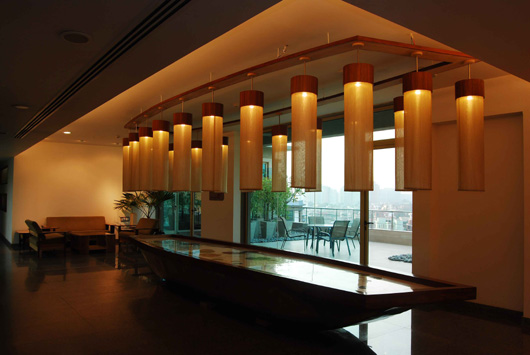

Sustainable “Carbon Footprint”: The architecture is used to develop the building marked by energy efficiency, operational convenience, low operational cost and optimized investment costs. It focuses not only on the façade, sun shading, and lighting details but above all, also on minimizing the energy consumption of the building while optimizing natural light consumption. The building is glazed on the benign North face and on shaded facades with higher performance glass responsive to the conditions. On exposed and direct heat receiving faces a solar façade of small openings set up high on the floor allow less direct heat and maximizes penetrations of light into the plate.

Parking and Transportation: The insatiable demand for parking is met by the provision for a double stack parking system (that addresses the needs of commuters), extra capacity preferred parking spaces for car poolers, and parking for the electric shuttle to connect with the future metro nearby. This facilitates an office building without visible cars and frees the ground to landscape and a pleasing outdoor environment.

Returning the Ground to Landscape: The building consists four interconnected floor plate blocks of varied size and scale organized around climate-modifying, natural-light-giving courtyards. These floor plates are independently equipped with amenities/ facilities for all modern office requirements.

- Contextual Responses
- Modular Back-Up Generation
- Thermal Storage Chillers
- Security and Surveillance
- Independent Controlled Floors
- Replenishing Ground Water
- Recycling Waste and Water
- Sociability-Features and Movement